Showing posts with label software testing. Show all posts

Wednesday, May 19, 2010

Test Estimation Based on Testware

I had a conversation recently with one of my clients about test estimation based on manual test cases. As I have written previously, I feel that in many ways test estimation is inherently flawed for a variety of reasons.

However, there is a technique I have used over the years that plays on risk-based approaches. This technique can be applied to testware, such as test cases. Just remember this is not a scientific model, just an estimation technique.

What is Testware?

Testware is anything used in software testing. It can include test cases, test scripts, test data and other items.

The Problems with Test Cases

Test cases are tricky to use for estimation because:

  1. They can represent a wide variety of strength, complexity and risk

  2. They may be inconsistently defined across an organization

  3. Unless you are good at measurement, you don’t know how much time or effort to estimate for a certain type of test case.

  4. You can’t make an early estimate because you lack essential knowledge – the number of test cases, the details of the test cases and the functionality the test cases will be testing.

Dealing with Variations

“If you’ve seen one test case, you’ve seen them all.” Wrong. My experience is that test cases vary widely. However, there may be similarity between some cases, such as when test cases are logically toggled and combined.

A technique I have used to deal with test case variation is to score each test case based on complexity and risk, which are two driving factors for effort and priority.

The complexity rating is for the test case, not the item being tested. While the item’s complexity is important in assessing risk, we want to focus on the relative effort of performing the test case. You can assign a number between 1 and 10 for the complexity of a test case. It may be helpful to create criteria for this purpose. Here is an example, You can modify it for your own purposes.

1 – Very simple

2 – Simple

3 – Simple with multiple conditions (3 or less)

4 – Moderate with simple set-up

5 – Moderate with moderate set-up

6 – Moderate with moderate set-up and 3 or more conditions

7 – Moderate with complex set-up or evaluation, 3 or more conditions

8 – Complex with simple set-up, 3 or more conditions

9 – Complex with moderate set-up, 5 or more conditions

10 – Complex with complex set-up or evaluation, 7 or more conditions

This assessment doesn’t consider how the test case is described or documented, which can have an impact on how easy or hard a test case is to perform.

Assessing Risk

Risk assessment is both art and science. For estimation, you can be subjective. In fact, my experience is that risk assessment is subjective at some point or other.

This scale is based on the risk (impact) of the test case and its priority in the test. Like the complexity ranking, here are sample criteria you can adapt for your own situation:

1 – Lowest priority, lowest impact

2 – Low priority, low impact

3 – Low priority, moderate impact

4 – Moderate priority, moderate impact

5 – Moderate priority, moderate impact, may find important defects

6 – Moderate priority, high impact, has found important defects in the past

7 – High priority, moderate impact, new test

8 – High priority, high impact, may find high-value defects

9 – High priority, high impact, has found high-value defects in the past

10 – Highest priority, highest impact, must perform

Actually, the risk level could be seen from two perspectives - the risk of the item or function you are testing, or the risk of the test case itself. For example, if you fail to perform a test case that in the past has found defects, that could be seen as important enough to include every time you test. Not testing it would be a significant risk. The low risk cases would be those you could leave out and not worry about. Of course, there is a tie-in between these two views. The high-risk functions tend to have high-risk test cases. You could take either view of test case risk and be in the neighborhood for this level of test estimation.

Charting the Test Cases

To visualize how this technique works, we will look at how this could be plotted on a scatter chart. There are four quadrants:

1 – Low complexity, low risk

2 – High complexity, low risk

3 – Low complexity, high risk

4 – High complexity, high risk

Each test case will fall in one of the quadrants. One problem with the quadrant approach is that any test case in the center area of the chart could be seen as borderline. For example, in Figure 1, TC004 is in quadrant 4, but is also close to the other areas as well. So, it could actually be in quadrant 1 if the criteria are a little off.


Figure 1

For this reason, you may choose instead to divide the chart into nine sections. This “tic-tac-toe” approach gives more granularity. If a test case falls in the center of the chart, it is clearly in section 5 (Figure 2), which can have its own set of test estimation factors.


Figure 2

All You Need is a Spreadsheet

With many test cases, you would never want to go to the trouble of charting them all. All you need to know is in which section of the chart a test case resides.

Once you know the complexity and risk scores, all you need to know are the sections on the chart. For example, if the complexity is 3 or less and the risk is 3 or less, the test case falls in section 1 of the nine-section chart. These rules can be written as formulas in a spreadsheet (Figure 3).

Figure 3

Sampling

So, what if you don’t have a good history of how long certain types of test cases take to perform? You can take samples from each sector of the chart.

Take a few test cases from each section, perform the test cases and measure how long it takes to set-up, perform and evaluate each test case.

You now extend your spreadsheet to include the average effort time for each test case (Figure 4).
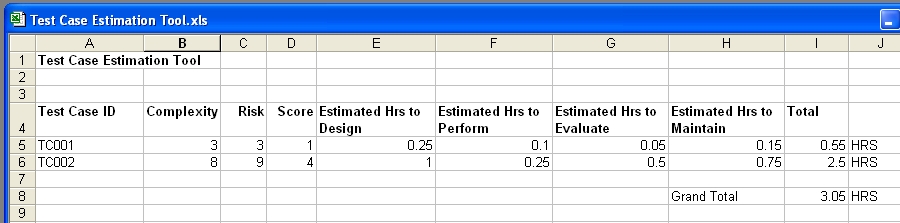
Figure 4

Adjusting

Your estimate is probably inaccurate. There is a tendency to believe the more involved and defined the method is, the more accurate the estimate will be. However, the reality is that any method can be flawed. In fact, I have seen very elaborate estimation tools and methods which look impressive, but were inaccurate in practice.

It’s good to have some wiggle-room in an estimate as a reserve. Think of this factor as dial you can turn as your confidence in the estimate increases.

Conclusion

Like with any estimation technique, at the end of the day, there could be any number of things that could impact the accuracy of most estimates. Estimates based on test cases can be helpful once you have enough history of measuring them.

Sampling can be helpful if you have no past measurements, or if this is a new type of project for your organization. It is still a good idea to measure the actual test case performance times so you can incorporate them in your future estimates.

I hope this technique helps you and provides a springboard for your own estimation techniques.

Friday, February 05, 2010

Book Review - Managing the Testing Process, 3rd Ed. – Rex Black

Managing the Testing Process, 3rd. Ed. by Rex Black

Published by Wiley, 2009, 638 pages

In the third edition, Rex extends a work he started in 1998 with the first edition. At that time, and still today, practical books on software test management are in a minority of the books on software testing. This book has become a commonly referenced work on software test management for a reason - it is practical.

Two things I really like about this book are that it is very readable and it has broad coverage of test management topics. As a trainer of thousands of test managers, I have learned that many test managers are thrust into the role with little knowledge or preparation. So, my perspective is that test managers need to know the mechanics of the software test profession as well as the managerial and leadership aspects of the job. This book delivers well on both counts.

By reading and applying the information in this book, you will learn the testing process from test planning and building the test architecture to building a test team, measuring test results, and conveying those results in a value-added way. Rex covers topics that are very relevant including test outsourcing and the context of projects and software lifecycles. I also very much appreciate the discussion of dealing with the people issues in testing.

Just a note on the use of spreadsheets and vendor non-specific tool examples is that once you understand the structure of organizing testware, you can apply that structure in a specific test tool. Plus, not everyone owns a commercial test management tool. I know many people who manage a lot of test items using Excel.

I can highly recommend this book to test managers and leaders, as well as people who aspire to be in those roles.

Randy Rice

Wednesday, February 04, 2009

Five Ways to do More With Less in Software Testing

It seems that many test managers are in the squeeze of tight testing budgets or no budgets at all. That means there is a lot of interest in doing more with less. The economy is bad, but we still have the need to do software testing well.

While I understand the need for efficiency in today's economy, this is not a new message. When I first started training in software testing back in 1990, there was a recession underway. There was also a quality crisis as U.S. manufacturers were battling against higher quality foreign imported items which included everything from VCRs to cars.

We learned how to recoup for the cost or quality with high-quality methods. This is what Phillip Crosby wrote about in his book "Quality is Free". In IT, however, the message of the economy of high quality has been lost over the years. In fact, in recent years I have found that senior IT and business management in many of the companies I have worked with will spend lots of money and take lots of risks with little to show for it.

So, for this window of time (hopefully a small stretch of time), the kinds of things I'll be discussing here have a home in the minds of people. However, the principles are profitable in any economy and we need to remember them.

#1 - Know What You are Doing

The number one value of training and skill building in my opinion is to learn the best and most efficient ways of doing things. After all, someone with no training could attempt just about any job but the results wouldn't be very good in most cases.

In software testing, there is a popular misconception that anyone can test. I have learned that many people have the ability to test, but there are skills that must be developed before someone can do a decent job of testing. And, some people just don't have the mindset or patience to be a good tester.

Training is how you learn what to do at the right times. Repetition is an important part of the training process. So, a three-day class once a year isn't enough to build skills.

Training can be expensive, but doesn't have to be. There are effective options:

* Self-study on the web and by reading books
* Team study such as reading and discussing the same book for a month or more
* Design and conduct your own in-house mini-course
* Have someone share a great new technique or tool at each test team meeting
* Webinars and teleconferences
* E-learning - its better than it used to be!

#2 - Reuse What You Use

This is really basic, but can be a big timesaver. If you have a good test plan or test strategy for one project, make a template and use it as the basis for other projects.

This idea can extend to detailed test design and test automation.

Perhaps the hardest part of reuse is managing the items as they are shared. This is the situation when people share and reuse test cases and test automation. There must be control over the items.

#3 - Define Tests Efficiently

There is an economy of testing. More tests are not necessarily better. In fact, each test case you have is one more you must maintain and perform. If a test case isn't adding specific value to your understanding of the software under test, you should consider why it is in the test.

Many people are surprised that once they start to analyze combinations of tests, how few tests they actually need.

While not every project is a good application of pairwise testing, it is a good technique to explore and try.

#4 - Automate Well

There is a great potential in good test automation. Some have realized this value is actual practice while others still struggle. In my experience, test automation is one of those areas where you can spend a lot of money in a hurry with little to show for it.

There are some free test tools such as FitNesse (www.fitnesse.org) that can be helpful, as well as scripting languages. Other free tools are at www.opensourcetesting.org.

It's good to learn the lessons of automation on the free and less expensive tools before moving on to the more robust and expensive tools.

#5 - Learn From Your Defects

Each defect tells a story. If you take the top 10 defects (as measured by the frequency and impact) in the previous month and perform root cause analysis to learn why the defect occurred, you will make significant strides toward improving your processes. The main investment in this effort is time. It will also take management support to fix the processes. However, these are things you can often do with very little direct cash outlay and they yield big value.

#5.5 - Bonus - Write and Use Checklists

Checklists are easy and inexpensive to create. They help improve processes and prevent mistakes. They also add consistency as to how things are done. If you don't believe me about the value of checklists, ask a pilot.

Summary

Going back in time again, one of the first books I read when starting out as a consultant in the early 90's was Jerry Weinberg's, The Secrets of Consulting. One of the laws is the "Law of Raspberry Jam", which basically says the wider you spread something, the thinner it gets.

Like jam, you can only spread people and tests so far before they lose their effectiveness and value.

We should be lean and mean in our testing because we just don't have the luxury of time (and right now, of money). So it's a good thing to learn efficient ways of testing. Just remember there are limits.

To hear my podcast on this topic, visit http://recordings.talkshoe.com/TC-27009/TS-182201.mp3

Saturday, January 31, 2009

Software Testing e-learning

One of the best ways to stretch your training dollars - whether you are paying for training personally or from corporate accounts - is to consider e-learning.

Not only does e-learning cost less than live public or in-house training, it is a great solution for people who don't have the time to devote 7 or 8 hours (or 2 - 5 days) for training.

Studies have shown that e-learning is just as effective in getting the information across as live training. I think it may be even more effective because you can repeat material as needed. You can't do that in a live class.

It's also a great way to make sure everyone gets the same training no matter where they live.

And...for those training managers concerned about any trainer behavior (jokes, comments, etc.), e-learning is safe. No profanity, no inappropriate remarks, etc.

I have found that the key for effective e-learning is to interact with the instructor. That's why I offer teleconference sessions for my e-learning participants. You get the chance to ask questions and interact with me. Of course, I am always reachable by e-mail and try my best to answer questions by phone.

These are just a few of the benefits of e-learning. If you want to learn more about my e-learning courses (I have 13 of them now, including an ISTQB foundation level course), just visit http://www.riceconsulting.com/training/e-learning.htm.

To experience free demos of any of my courses, just visit http://www.softwaretestingtrainingonline.com/moodle and select the demo section. You can login as a guest.

To buy a course, just visit www.mysoftwaretesting.com. We have a sale on right now!

Riceconsulting.com banned from Google

Well, the saga continues. Because of the redirects on my site, then my subsequent removal of the malicious links, I have been banned from Google. I'm not upset at Google - I understand their need for maintaining integrity in the search results.

It is frustrating to go from the #1 listed site for "software testing consulting" and the #4 site for "software testing training" to not even being in the search results at all.

So, if you are looking for me on the web, I hope this post helps you to find me.

I have gone through the steps to request re-inclusion and hope to be back in there soon.

Monday, December 29, 2008

COTS Testing Course is Now Online

I'm excited to announce the launch of my 14th e-learning course, Testing Commercial Off-the-shelf (COTS) Applications. This online course gives you the approaches you need to test commercial software. Many organizations, especially government, have been building systems comprised of commercial software. However, problems arise when people try to integrate the products to work together. Many people work under the misconception that all you have to do is buy the software, install it, maybe configure a few things and then start using it. Unfortunately, the truth is that there are a lot of things the vendors can't test. This course will lead you through a process of testing COTS products all the way from selection through maintenance.

To see a free demo of this course, just visit http://softwaretestingtrainingonline.com/moodle/course/view.php?id=45. To buy a registration, go to https://www.mysoftwaretesting.com/ProductDetails.asp?ProductCode=COTS101.

To see all the details about my e-learning courses and how they can help you build your skills on your own schedule, visit http://www.riceconsulting.com/training/e-learning.htm.

Thanks!

Sunday, November 16, 2008

Thoughts About EuroStar 2008


I thought EuroStar 2008 was a great conference. The tutorials, keynotes and tracks were strong in my opinion (I must also say I want to give my perspective as an attendee as well as a speaker. It's hard sometimes to step back and be objective, but I'll try.).

One of my tests of a good conference is whether I'm torn between attending track sessions - and I was. I also spent a fair amount of my time in the interactive sessions, such as the ones on the testing manifesto and testing standards. It was nice to be working on things to advance our testing profession. I'm not sure where the whole testing manifesto thing will wind up. I hope it is someplace similar to the agile manifesto - something simple, meaningful and easy to read and remember.

James Whittaker was his insightful and entertaining self (that video he shows about the future of medical software is amazing and shows we're going to need better testing). His talk was "The End of Testing as we Know it", and I felt all the keynote speakers made me think. James Lyndsay spoke on "Becoming Agile - Reshaping Testing for an Agile Team." He had great points and I'm always impressed by the simplicity and impact of his slides!

The expo was amazing. In the U.S., the exhibits tend to be rather bland. In this show there were two coffee bars, a cocktail bar (I had a smoothie), a chess match, a bicycling competition, etc.

They had a contest where if you got all the exhibitors to stamp your card, you could enter the drawing. So, I computed my odds (about 1 in 30, I figured) and went for it. The grand prizes were two free passes for next year's conference and eight Nintendo Wiis. All I wanted was a Wii. Guess what? I won a conference pass. I didn't factor that in my odds! Oh well, I don't have the luggage space or weight anyway.

The gala was also fantatstic. It was held in the Grote Kerk, which is a former cathedral. It was big night for me, winning the best tutorial award. Thanks so much to the 60 or so people in my "Becoming an Influential Test Team Leader" tutorial that made that happen. It was totally unexpected! Much more important than the award was that we experienced and learned things together that will help us be better in our leadership roles.

My prize was a beautiful 9 pound Waterford crystal vase which I will find a great place for at home. Thankfully, security in the U.K. has relaxed security rules to allow two carry-on pieces of luggage!

One other thought concerns model-based testing and how it differs in Europe than in the U.S. - At U.S. conferences, model-based testing is often presented as a manual process. In Europe, they talk about the tools that can make model-based test design happen faster and more completely than using manual methods. I just thought that was interesting.

Dot Graham will be the chair for next year's conference in Stockholm, Sweden. I wish her all the best!

I would like to thank all the kind people who helped me feel right at home. Many thanks to the Qualtech Conference team - Tracy, Siobhan, Lorraine and others. Also, thanks for the conference committee for selecting my talks and to John Fodeh for my keynote introduction and to Bob van de Burgt as conference chair. You all did a great job!

Wednesday, August 06, 2008

Integration and Interoperability Testing of Software

My last post about the American Airlines baggage system failure mentioned interoperability testing and it got me thinking about this important type of testing that is often minimized or overlooked in systems testing.

First, I just need to make a distinction realizing that software testing terminology is often applied in a variety of ways depending on how you were exposed to it. For example, a test case can mean many things to different people. Although standard definitions exist, they are often unknown to professional testers.

So, here are my working definitions:

Integration testing is the verification or validation that data and control can be passed correctly between two or more related systems or system components. In other words, "Can each component or system talk to each other correctly?"

Interoperability testing is the verification or validation that data and control, once passed correctly between two or more related systems or system components, can be applied correctly to achieve the expected results or behavior. In other words, "Can the passed data or control be used correctly to get the right outcome."

The idea is that it's one thing to have integration between items, but another for that integration to be applied correctly. By the way, the definitions I used are the same or similar to that used in defense applications where integration and interoperability testing is paramount.

I consider integration testing a phase or level of testing performed once the related items or systems are available. I consider interoperability testing a type of testing, which can be performed at any phase of testing, from unit to user acceptance testing.

Here's a fictitious (but realistic) example of the two tests in action based on some of my previous rants (er.., comments). Let's say that I am passing some data to another system for sending a passenger's bag to the right destination - either the conveyor belt to be picked up, or on to their next flight. The integration test would tell me if the data made it correctly to the sorting system. The interoperability test would tell me if the sorting system processed that data correctly, made the right determination, and then sent the bags to the correct destination. It is possible that a logic error could send bags that were meant to be on a connecting flight to the conveyor belt for pickup. (NOTE: I must emphasize this is just an example and not what happened with the American problems. It may have been something similar, but the information is not available yet to know what happened.)

The lesson we can all learn is that this type of end-to-end interoperability testing is hugely important but not necessarily easy. Many times it requires validation in the actual operational environment to get a true assessment of correctness.

By the way, I offer a course in Integration and Interoperability Testing.

One more realted note - I found this link to one of my favorite articles from Scientific American on software defects. It's called "Software's Chronic Crisis". Although it's from 1994, don't let the date keep you from reading this very informative article. I'm really glad I found it!

Do you have any experiences with performing (or not performing) interoperability testing? If so, I would love to read your comments.

Thursday, April 17, 2008

Software Testing Disasters

Thanks to everyone who turned out at the Red Earth QA meeting today in Oklahoma City!

Here are the slides for my presentation, Testing Disasters and Turnarounds in PDF. I hope to have the audio available soon!

I'll be presenting this as a track session next month at StarEast, unless American Airlines grounds their fleet again.

Thursday, April 10, 2008

Interesting Software Testing Survey from EuroStar 2007

I ran across an interesting survey that my friends Dorothy Graham and Mark Fewster conducted last December at EuroStar 2007, held in Stockholm. 620 attendees participated in the surveys.

You can download the survey results at:

http://www.qualtechconferences.com/content.asp?ID=263

It's interesting reading. Plus, I think it's great that Dorothy and Mark were able to conduct the survey and report the findings at the same conference. That's cool.

Here's what I found interesting:

59% of the respondents used to write code

43% held the ISEB/ISTQB Foundation Level certification

34% of those with certifications felt that they now know more about testing, and 25% have a better job

11% of the respondents saw the ISTQB certification as a money-making scheme, 49% felt that is shows a basic level of knowledge.

36% of the people have read at least half of 1 - 2 testing books, 20% have read none and 36% have read 3 - 10 books.

50% of the people do not measure the value of testing in their organizations

Well, those are just a few of the findings. I encourage you to download the report and read it yourself. We need to do something like this survey here in the U.S.

Wednesday, April 09, 2008

ISTQB Software Testing Certification Training

I'm in Dallas this week working on a project that I can't talk about. Well, I could but then...OK, you know the line.

Funny thing. I was here last week and my car got pummelled with quarter-sized hail. About $1,500 in damage. Just got it estimated for repair on Monday. I hadn't been here two hours last night when another hail storm was heading my way. So...I dragged myself out into the rain and moved by already hail damaged car under the hotel entrance. Guess what? Nothing happened. Yea! All you people at the Hampton Inn owe me thanks for keeping the hail away.

I'm happy to announce that I have submitted my Foundation Level Course in Software Testing for accreditation. You can read the press release here.

Hopefully before long, I'll be able to display the ISTQB logo and really get out there promoting the course. My goal is to get as many people certified as possible.

Why?

I think everyone in the field of software testing has an opinion about certifications. I don't believe there is a single "right" perspective. What appeals to one person may not appeal to someone else.

I am CSTE #2, which means I was there at the start. I was a designer of the certification. I am now an officer of the ASTQB, which means I now support wholly the ISTQB program. A big reason I am behind the ISTQB program is because it is vendor-neutral. It's true that people (including me) will make money conducting training courses. But if I wasn't presenting this course, I would be presenting something else. However, no one company "owns" the certification. No vendor can just change the program. In fact, there are many training providers which gives you more options.

Training is not required to sit for the exam. However, I really believes it helps because you get immersion in the terminology and philosophy of the ISTQB syllabus.

Do test certifications help your career? It depends on your situation and your goals.

I know some test managers that could care less about people who are certified and I know others that are certain that having a certification increases their test team's image in the organization. Some people find great value in using test certification as setting a baseline of software testing terminology and practice in an organization. My belief is that having a certification is one way to stand out in your career.

I have personally had clients tell me the deciding factor in using my services was because I held a certification.

There have been debates on this topic, so there are views on all sides.

I have some really cool things in the works that I can't reveal just yet regarding ISTQB test certification training. I'll just say that I'm very excited about doing some things that no one else is doing in software testing!

If you want to get training in ISTQB Foundation Level Software Testing, call me at 405-691-8075, or contact me through my web site to discuss.

Have a great one!

Randy

Monday, April 07, 2008

Making Software Testing Training Green

It's tough sometimes to break out of a mold. That's where we seem to be where training is concerned. Traditional classroom testing has the opportunity to be engaging, but too often it isn't. You have to work at it.

So when I start talking about e-learning, people get concerned about the interaction aspects. And interaction is important! It can be achieved with e-learning.

There are other considerations, such as environmental concerns. With e-learning:

  • You eliminate travel, therefore reducing fuel used in airplanes and cars

  • You eliminate the big books, therefore reducing the amount of trees used for paper

  • You reduce or eliminate the need for a physical facility to heat or cool for a class of 15 or more peopleBut even above the environmental impact, you can save big money and get training that is just as effective as live training!

Then, there are time and cost concerns. E-learning can be scaled up much faster and broader that live on-site training. For example, with my e-learning courses, it is possible to train you entire worldwide test organization in one week for a small fraction of live in-person training.


I like the time-shifted approach. In fact, I believe on-demand content is essential to make e-learning effective. It's just too difficult to co-ordinate everyone's schedule to be connected at the same time. Plus, you eliminate many of the concurreny and performance issues of having many people accessing the same content at the same time. (On the launch of Oprah's new online training event with author Eckhart Tolle, author of "The New Earth", 500,000 people tried to access the event. "Tried" is the key word.)


While you won't have this type of load, you can still have problems with load.


My entire attitude toward training changed after 9/11. It was tough for anyone in the training business for some time because so many people were on travel restrictions. Many conferences were cancelled.


If fuel costs continue to soar, travel costs will also rise. E-learning just makes sense on a variety of levels.


If you want to learn more, check out my e-learning offerings in software testing, IEEE standards and user requiremnts here.

Speaking of green, here is my favorite fishing spot.
It is Bear Lake, close to Cuchara, Colorado.

That's why I say that a bad day of fishing is better than a good day at work!

Wednesday, April 02, 2008

What Makes Software Testing Training Effective - Part 2

Today I did something that many of my friends have advised me to do for many years. I had my head examined. Really.

I had a brain MRI performed because I have tinnitus in my left ear and in order to rule out a tumor, I had to get this done to get life insurance.

The funny thing is that there was power surge about 10 minutes into the process and they had to "re-boot" the MRI machine. I told them not to worry. "It's not you, it's me! I'm a tester."

To add on to my last post about software test training effectiveness, I was thinking about something I've been intending to post for some time.

That is, to learn in small doses is more effective than trying to train in large chunks. Now, this is just the opposite to how many people think. They want to cram as much information as possible into a training day. The problem is that people start to suffer from information overload.

One of my mentors, Fred Smith, said that, "The best mentoring is intensity in a narrow field...learn, practice and assimilate." He used the example of how he used to dramatically improve the performance of salespeople by teaching just few simple techniques repetitively. Then, the people would go out and try them. When they came back, they all had glowing success stories.

It also reminds me of a friend who is a great guitarist who told me the secret to playing fast is to play slow.

So, for software testers, I suggest in really drilling down into one technique. In one of my intermediate testing courses, I spend two days just teaching and practicing pairwise testing. We spend about three hours on learning how to find the right size orthogonal array. We spend a hour on how to use some of the pairwise tools that are free. I guarantee you one thing. When the workshop is over (it's really not fair to call it a class), people know all about pairwise testing.

By the way, if you would like a taste of this class, attend my Tuesday half-day tutorial at StarEast in about a month.

You will find that some people want to just breeze through the material quickly. These people just want to cut to the chase. They are likely to get impatient when the class wants to discuss questions and observations - you know, where learning actually occurs! I like to set expectations by letting the class know that the goal is not to get through all the slides. It's to internalize the information. So, I encourage people to enjoy the journey!

Remember, another way to make training stick is to take it in sips instead of gulps!

Tuesday, April 01, 2008

Software Testing Training - What Makes it Effective?

Man, it's been busy here in the office today, but I love it!

I've been thinking a lot about really what makes training "stick", especially in software testing and software quality. Actually, I've been thinking along these lines for several years.

It was a defining moment when back in 1998, I re-designed my testing courses to be "hands-on" computer-based. Then, in 2001 I attended an AYE conference and that put another spin on things for me. (BTW, I highly recommend that conference!) It caused me to add many more experiential activities to my training.

So, why doesn't training "stick"?

Well, besides the basic things like:

You get out what you put into it.
Learn, then apply.
etc...

1) I have observed that my very best training experience, both as trainer and trainee, is when stretching happens. When training doesn't stretch you, it's easy to just coast along and not change anything.

I think learning should result in some form of change. If it doesn't result in change, then has anything been accomplished? After all, there should be some form of improvement seen.

But, back to stretching...

Stretching happens when you have to think long and hard about how to solve a problem. It happens when the case study software messes up and then you have to troubleshoot, learn, test, try again, fail, try again and FINALLY get it right.

Some people complain that the case study should have been more trouble-free. Then, they don't believe that I designed it that way!

Training sticks when people fully understand WHY certain things are done WHEN they are done. Unfortunately, too many trainers focus on the WHAT and HOW, which is great for robots, but not great for transforming people into thinking testers.

So, I'll warn you in advance. If you attend one of my sessions, you will probably be stretched. It's not because I'm mean, it's because I want you to remember.

2) People remember stories more than bullet points. I have had people tell me they didn't remember the bullet points on my slides, but they remembered some of those great project stories. (By the way, my track session at StarEast will be "Testing Disasters and Turnarounds" which will be based on three situations where things went really bad and how some of them were corrected.) You will also hear some good stories in my training sessions.

3) People learn better when things are light. So, I like to use humor tastefully and keep things loose and informal in the sessions I teach.

Here's another take which has a really good example:
http://newsweaver.ie/qualtech/e_article001048145.cfm?x=bcnrJV7,b4V6LhgS

That's it for now. I would like to hear what you think makes training effective!

Friday, December 14, 2007

Lessons Learned in a Boston Snowstorm

Well, I'm trying to get home from a class (Adding Value to QA and Testing Processes) I presented in the Boston area this week. It was a great session and I really enjoy teaching people who are engaged in the topic. I was so glad to be able to actually get to the class because in Oklahoma City we were hammered last Sunday by a devastating ice storm.

There were lots of trees destroyed and 700,000+ people without power at some points. (My thanks to the folks at OG&E and the people who came in from outof state to help us! God bless you!) In fact, my flight was one of the first to take off Tuesday afternoon, as the airport had been pretty much shut down most of the weekend.

As it turned out, I was jumping out of the refrigerator into the deep freeze!

As those of you in the U.S. know by now, Boston was hammered by a snow storm on Thursday (Gee, it seems like last week already!). Here's what made it interesting.

Despite the warnings and planning, most of the state was paralyzed. In fact, the warnings may have actually contributed to the problem in a major way.

It took me 4 and one-half hours to travel about 16 miles on the highway. The highest speed I reached was 15 mph, and the average was about 4 mph. I was not alone. In fact, I fared pretty well as compared to some.

The crazy thing was that the snow wasn't that bad. Listening to the radio was a riot. People who have lived there all of their lives were ranting about "what's happened to us here?" I'll admit, as a "Okie", I was thinking that even we handle winter weather better that this. (No offense intended.)

Here's what I think happened and it applies in other situations as well. Warnings went out the day before that the snow would hit during the evening rush hour, so people should plan on leaving work early. So, as people are (including myself), we waited until it started snowing around 1:00 p.m., then left. It was snowing about 1" per hour, so it didn'y take long for it to start getting messy.

However, because EVERYONE left work early, rush hour started at 1:00 instead of 3:00 or 4:00. So, the snowplows couldn't move the snow because of all the people trying to get through the snow. What irony! You might say, the perfect storm.

As much as the weather caused a problem, so did people's response to the weather. I think we may have been better off just giving the forecast and letting people figure out for themselves when to leave work.

We see the same thing happen with software and systems. Consider the web site to buy concert tickets that only gives people two minutes to complete the transaction. Because of the heavy load seen when the tickets go on sale, it's hard to get the response time to finish in two minutes! (As you can tell...I have experience in this scenario.)

When thinking about system performance, give very careful consideration about what people may do that could actually aggrevate problems (like hitting the Enter key multiple times just to make the system go faster). That's why good system performance (and weather response) needs to be well thought-out.

While we can't control what people do, we can influence what they do.

OK, lesson learned. If all goes well, I should get home to Oklahoma City just in time for another snow event. I think I feel a "sick day" coming on.

Sunday, October 28, 2007

StarWest 2007 Recap

Hi everyone!

Janet and I had a good week at StarWest last week, along with 1,300 or so of our fellow software testers. I thought I would pass along a few observations for those of you who didn't make it there.

First, many thanks to SQE for inviting me to speak again this year. And many thanks to those who attended by tutorial on Becoming an Influential Test Team Leader and the track session on Taming the Code Monolith – A Tester's Perspective. I plan to have the narrated slide show posted this week sometime.

The full-day leadership tutorial is always a joy to present because I get to meet so many people from all over the world that want to be the best at leading their team. We had over 100 people in the tutorial, which can be a challenge in terms of exercises, but those went well.

I sometimes wonder why some people do the things they do, but I also realize that you can learn a lot by just observing. Case in point – there was one lady on the very front row that from the outset of the workshop chose to read a magazine. Everyone else was engaged and appeared to be interested.

At the first exercise, she left and didn't return. The interesting thing is that the exercise involved working in small teams and everyone getting a card. Each card had a different action or indicated a role. She must have gotten the card that read “You are the Leader!” because that team started the exercise and learned they had no leader. However, someone in the team stepped up with no prompting and led. I guess I know who the real leader was!

I wasn't offended that she left and I truly hope she found a session that was more to her liking. I just could not help but note the contrast between the people who were engaged and those who just sit back and watch. That's why I give everyone a chance to participate – ask a question, share a tip, debate a point, you name it.

So, if you ever attend one of my leadership workshops be prepared. You may be called upon to lead!

By the way, we also made our own list of major testing challenges. We arrived at 30 of them! Guess what, there were none that were purely technical. Most were human in origin and a few were both human and technical.

As for keynotes, one of my favorites was Dot Graham's and Mark Fewster's (Grove Consultants, UK) keynote address on the “Five Doings of Software Testing”. It's not easy to do a duet keynote and they did it very well. On every “doing” they kept the audience engaged. The five doings are searching, checking, assessing, measuring and sampling.

Another keynote address I really liked was Lee Copeland's “The Nine Forgettings.” It was all about the things it seems we software testers have forgotten in recent years, such as lessons from the early pioneers of our field. (Only a few people could name even three out of seven of the pioneers on the slide.) It was a great session to remind us that we need to keep the foundations in mind. Lee handled an interesting group of questions toward the end on topics ranging from the future of testing to the value of test certifications.

My favorite presentation on SOA (Service-Oriented Architecture) was by Brian Bryson of IBM. He used the basic Eclipse framework to build and test a simple web service. He presented some lessons learned by the teams at IBM and was just overall a very informative presentation. By the way, there was a decent sized group in the room and it seems that quite a few people are looking to learn how to test SOA. That's encouraging as I am rolling out my new SOA Testing course in two weeks!

I finally got a chance to attend Julie Gardener's (of Grove Consultants, UK) presentation on classification trees. Julie did a great job and her session brought me up to speed quickly on this technique which I plan to add to my intermediate testing course.

Speaking of the “Grovers”, they all did a great job and I appreciate them making the long trip over. They always share very valuable information in very engaging ways. Lloyd Roden presented his Top Ten Testing Myths and Illusions talk, which is always a great session to get people thinking about testing.

(Thanks to the Grove Players for inviting me to be part of their "A Christmas Carol - Testers Version". That's one of my favorites!)

One final note is on Robert Watkin's presentation on the Top Ten Signs You Need to Improve Your Testing Process. I felt a special sense of appreciation for his presentation since we both hail from Oklahoma City and I was able to give him a little advance feedback. Robert had a good sized group in his session and I liked the way he opened up the session for other people to contribute their experiences. Job well done!

I regret that I didn't see the “Testing on the Toilet” presentation by Bharat Mediratta and Antoine Picard from Google. I heard good things about it.

As I close this posting, my thoughts and prayers are with the people in California who have lost their homes and possessions in the fires which started last week. Last week was brutal weather-wise. Temps were in the high 80s+, winds were very high (clocked at over 100 mph on the mountain tops – I estimate about 60 mph at the hotel) and the smoke was everywhere. In the DFW airport on the way home I saw the interview on Larry King's show with Ken Blanchard, who lost his home in the fires. His attitude and faith are an inspiration to me. His words of wisdom were that his family was safe and that's what mattered most, He told about how his church and Christian friends had rallied around him and the other victims. That's how it should be – the Church being there for people.

Thanks for reading this long and winding post. More to come soon.

Best regards,

Randy